RTMS

Repetitive Transcranial Magnetic Stimulation

RTMS (Repetitive Transcranial Magnetic Stimulation) is an advanced, non-invasive medical technique that has shown promising results in treating various mental health conditions. At Neo Clinics, we offer this therapy to help improve mood and overall well-being, enabling patients to live with greater confidence and energy.

At Neo Clinics, we understand that mental health is an essential part of overall well-being. We are committed to providing high-quality care with treatments tailored to individual needs. Our qualified professionals have extensive experience in RTMS and other modern therapies, ensuring reliable and professional treatment.
Why Choose Us?

Safe and effective

RTMS has been scientifically proven to be a safe and effective treatment option for people with various mental health conditions.

Customization

Our treatments are tailor-made, taking into account your individual needs and health goals.

Recognized therapy

RTMS is internationally recognized as a promising treatment option for various neurological and psychiatric disorders.

Non-invasive treatment

RTMS is a non-invasive and non-drug treatment, meaning there are no systemic side effects often associated with medications.

No Downtime

Designed to fit seamlessly into your routine, with no recovery period required. You can return to your normal daily activities immediately after each session.

Time-Efficient Sessions

Depending on the protocol used, sessions typically last between 3.5 and 20 minutes.

How does rTMS work?

The mechanism of action of RTMS is based on the principle of electromagnetic induction. Using concentrated magnetic fields, we can stimulate or slow down specific areas of the brain. The precise location and method of treatment varies from person to person and is determined by brain activity, which can be easily mapped with a brain scan. The subtle changes in activity caused by RTMS lead to beneficial effects on a person’s mood, cognition, and behavior. RTMS is particularly well-known for its successful application in treating depression, where it can have positive effects without serious side effects. Research has also shown that RTMS can have positive results in other conditions, such as anxiety disorders, obsessive-compulsive disorder (OCD), post-traumatic stress disorder (PTSD), and certain forms of chronic pain.

What can you expect?

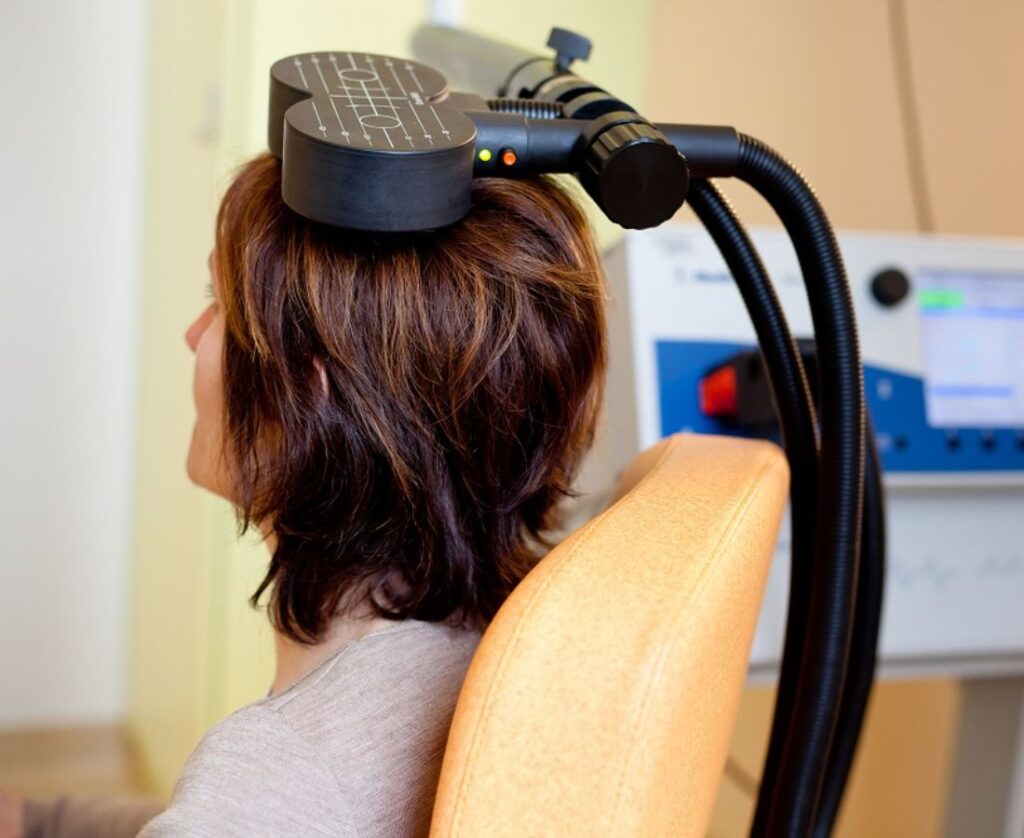
At Neo Clinics, RTMS is applied in a relaxed and comfortable environment. You sit in a chair, and a magnetic coil is placed a short distance from your skull. During a series of treatment sessions, usually spread over several weeks, the magnetic pulses are carefully administered to activate specific areas of the brain. The treatment is completely painless, and there are no serious side effects afterward. You can drive immediately after the treatment.

Patient Stories

RTMS is a non-invasive treatment in which magnetic pulses stimulate brain areas involved in mood regulation.

RTMS is used to treat depression, anxiety disorders, obsessive-compulsive disorder (OCD), post-traumatic stress disorder (PTSD), addictions, and chronic pain. Studies have also shown promising results in treating schizophrenia, ADHD, and migraines.

Citation:
1. Kar SK, et al. The efficacy of Transcranial Magnetic Stimulation in the treatment of obsessive-compulsive disorder: An umbrella review of meta-analyses. CNS Spectr. 2023;29(2):109–18. https://doi.org/10.1017/S1092852923006387

2. McClintock SM, et al. Consensus recommendations for the clinical application of Repetitive Transcranial Magnetic Stimulation (RTMS) in the treatment of depression.

3. Mahoney JJ, et al. Transcranial Magnetic Stimulation, deep brain stimulation, and other forms of neuromodulation for substance use disorders: Review of modalities and implications for treatment. J Neurol Sci. 2020;417:117149. https://doi.org/10.1016/j.jns.2020.117149

Most side effects are mild and temporary, such as headaches (10-20% of cases), muscle twitching, or fatigue after treatment. Serious side effects, such as seizures, are extremely rare and occur in less than 0.1% of treatments.
Depending on the type of therapy, the procedure takes 3.5 minutes or 20 minutes.
Yes, RTMS is often combined with medication or psychotherapy.
We do not perform RTMS on pregnant patients.

FAQ's