
Brain Scan (qEEQ)

Brain Scan (qEEQ)

At Neo Clinics, we offer comprehensive and targeted treatment for both mental and physical conditions. To provide you and your healthcare provider with a deeper understanding of the potential causes and treatment options for mental health issues, we offer a qEEG scan to gain insights into your brain activity.

A qEEG (Quantitative Electroencephalogram) is an advanced brain scan that measures and analyzes brain activity in detail. It provides an objective representation of brain waves and compares them against normative databases, allowing for the rapid detection of anomalies. It measures various brain wave patterns and provides information on how the brain is functioning. This detailed data enables a qEEG to help identify the underlying causes of issues or irregularities in brain activity.
Why a Brain Scan (qEEG)?

Objective Measurement of Brain Activity

The qEEG scan provides a precise picture of brain activity, which is essential for correct diagnosis and treatment.

Understanding Imbalances

It helps identify imbalances in brain activity that may cause issues such as ADHD, anxiety, sleep problems, or depression.

Determining the Most Effective Treatment

The scan results form the basis for determining the best treatment plan, such as neurofeedback or rTMS (transcranial magnetic stimulation).

By whom and for whom?

qEEG is widely used by neurologists, psychiatrists, psychologists, and therapists to diagnose and treat various neurological and psychiatric disorders. It is useful in identifying abnormalities that can contribute to conditions such as ADHD, depression, anxiety disorders, sleep problems, and traumatic brain injury. Furthermore, the qEEG scan is a valuable tool for athletes, executives, and biohackers who want to enhance their cognitive performance and optimize their brain activity for better focus, creativity, or relaxation. In these cases, it is often combined with neurofeedback or other performance-enhancing techniques.

How does a qEEG scan work?

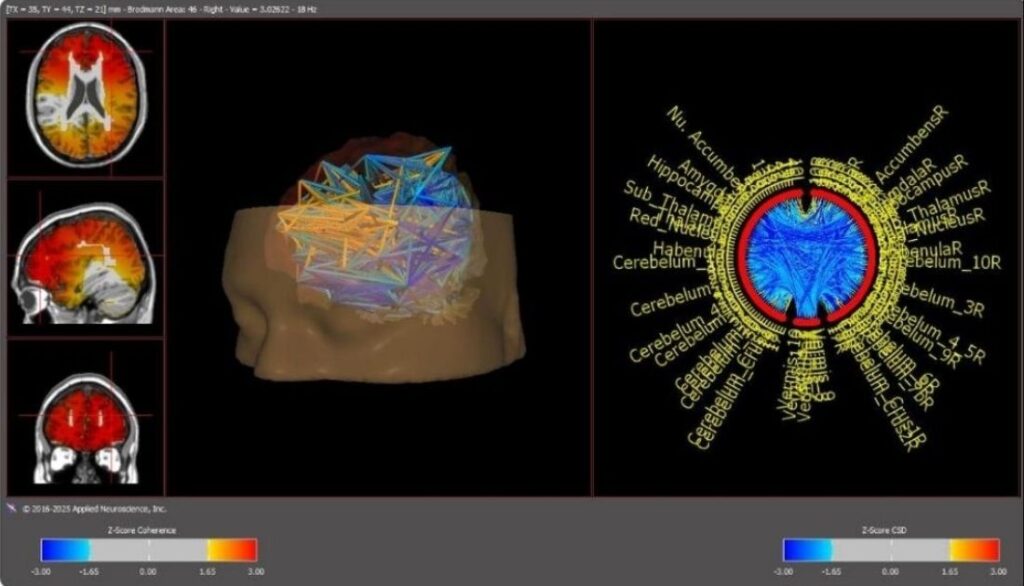
At Neo-Clinics, we use a special cap with electrodes (without gel) to read your brainwaves. This measurement takes only 10 minutes and is completely painless. During the measurement, you sit in a comfortable chair and can remain relaxed. The measurement is then digitized and analyzed. The obtained data is then compared with a normative database, which consists of a large population of people without complaints, to identify abnormalities in brain activity. This allows us to see which areas of the brain may be communicating less effectively and provides valuable insights into the cause of your complaints. The results are displayed in so-called “brain maps” or topographic maps, which show where abnormalities or imbalances in brain activity occur.

Patient Stories